BGU: A Single Skin Gene Helps Build the Body’s First Line of Immune Defense
Skin cells don’t work alone
The skin is often thought of as a passive shield, but it is also a highly active immune organ. For the skin to function properly, skin cells and immune cells must develop together. Until now, scientists have not fully understood how this coordination happens. “Our study shows that skin cells themselves actively support immune cells,” said Prof. Idan Cohen of BGU’s Faculty of Health Sciences, one of the study’s senior authors. “They don’t just build a wall—they create an environment that allows immune cells to survive and thrive.”
What the researchers found
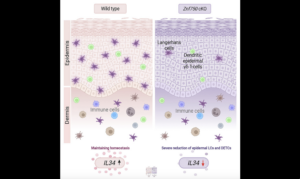
Using genetically engineered mice, the researchers removed ZNF750 specifically from skin cells while leaving immune cells untouched. The result was striking:
• Immune cells nearly vanished from the outer skin layer
• The loss was especially severe for Langerhans cells, which play a key role in immune surveillance
• Immune cells in deeper skin layers remained normalImportantly, the immune cells that did remain were fully formed and functional—they simply could not survive long-term in the skin
“This told us the problem wasn’t the immune cells themselves,” explained Prof. Roi Gazit, co-senior author of the study. “The problem was that the skin was no longer providing what they needed to stay alive.”
The missing signal: IL-34
The team discovered that ZNF750 controls the production of IL-34, a molecule released by skin cells that acts as a survival signal for Langerhans cells.
Without ZNF750:
• IL-34 levels dropped sharply
• Langerhans cells lost their support system and gradually disappearedIn effect, ZNF750 acts as a primary coordinator, ensuring that as the skin barrier forms, immune protection forms alongside it.
Why this matters for human health
Mutations in ZNF750 are already known to cause rare inherited skin disorders and to be linked to psoriasis, a chronic inflammatory disease. Langerhans cells are also reduced in psoriasis and atopic dermatitis, conditions marked by disrupted skin immunity. “These findings help explain why defects in skin structure are often accompanied by immune dysfunction,” said Prof. Cohen. “They also point to new therapeutic directions—perhaps restoring key support signals like IL-34 could help rebalance skin immunity.” Beyond skin disease, the study highlights a broader biological principle: tissues are built through constant dialogue between structural cells and immune cells. When that dialogue breaks down, disease can follow.
A new way of thinking about barriers and immunity
The research challenges the traditional view that physical barriers and immune defenses are built separately. “Our work shows that a single gene can coordinate both,” said Prof. Gazit. “It’s a powerful example of how the body integrates form and function—and why disrupting one part of the system can have far-reaching consequences.” The research was conducted by Lotem Adar, Sony Sharma, Bar Schwartz, and colleagues in the laboratories of Prof. Idan Cohen and Prof. Roi Gazit at Ben-Gurion University of the Negev. It was supported by the Israel Science Foundation (Grants nos. 883/21; 1908/21).