Israel has joined the European Union’s MedFish4Ever Declaration
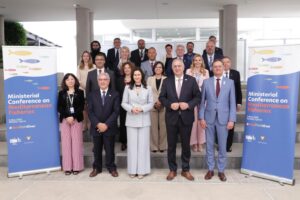
Israel has joined the European Union’s MedFish4Ever Declaration, a regional framework aimed at improving the management and recovery of fish stocks in the Mediterranean and Black seas.
Israel has joined the European MedFish4Ever initiative for the first time, a regional program aimed at restoring fish stocks in the Mediterranean and the Black Sea while promoting sustainable fishing practices. Representatives from Israel’s Ministry of Agriculture and Food Security participated this week in the regional ministerial conference held in Nicosia alongside Mediterranean and Black Sea countries.
During the conference, participating states reaffirmed their commitment to strengthening regional cooperation in order to restore marine resources. They also approved the launch of a new MedFish4Ever declaration in 2027, which will outline the strategic priorities for the next decade in the fields of fisheries and aquaculture across the Mediterranean region.
Key topics discussed included intensifying efforts against illegal fishing, implementing science-based fisheries management, supporting small-scale fishermen and younger generations entering the sector, adapting to the effects of climate change, and deepening regional cooperation through the General Fisheries Commission for the Mediterranean.
According to Israel’s Ministry of Agriculture, the Israeli delegation received a particularly warm welcome from Cyprus — which currently holds the rotating presidency of the Council of the European Union — as well as from several international officials in the sector, who praised Israel’s expertise in maritime regulation and fisheries management.
Since the launch of the MedFish4Ever initiative in 2017, nearly half of Mediterranean fish stocks have shown signs of recovery, particularly in areas where scientific policies, stronger monitoring systems, and enhanced enforcement measures have been implemented.
Despite this progress, major challenges remain, including illegal fishing, climate change, and environmental pressures that continue to affect marine ecosystems and fishing communities throughout the region.
Yaakov Poleg, Deputy Director General for Trade and International Cooperation at Israel’s Ministry of Agriculture, welcomed the country’s participation, stating that it “reflects Israel’s commitment to the responsible and sustainable management of marine resources, based on regional partnership and shared responsibility.”
A unified approach for the next decade
Participants identified five priority avenues to underpin the next declaration:
- Stronger governance: enforcing measures, combating illegal fishing and reducing fleet overcapacity.
- Science-led recovery: expanding management plans and protected areas and partnering with fishers in research.
- A fair transition: targeted support for small-scale fishers, generational renewal and gender equality.
- Climate resilience: adapting fisheries and aquaculture management and turning challenges such as non-indigenous species into opportunities.
- Solidarity and partnership: collective action anchored in a modernised General Fisheries Commission for the Mediterranean (GFCM).