Dr. Ido Ben-Dayan: Using a pencil and paper to unlock the secrets of the origins of the universe
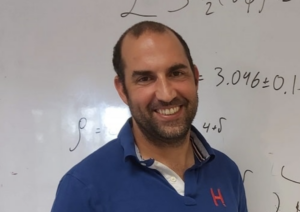
Dr. Ido Ben-Dayan is an explorer. Like Columbus or Magellan, he is searching for new worlds. He applies knowledge from the past to attempt to solve the great mysteries of the universe. Like the ancient Greeks, Newton and Galileo, he analyzes observations of these mysteries in an effort to make order and sense of them.
Ido Ben-Dayan is a theoretical physicist. While he is involved in the multi-billion-dollar LISA experiment https://lisa.nasa.gov, he spends most of his time using a pencil, paper and whiteboards to calculate the origins of the universe. Like Newton, although his theories may be proven incomplete, they may one day in the future be adapted by someone else. Says Dr. Ben- Dayan, “In principle I am involved in experiments like LISA and hope to join the Simons Observatory https://simonsobservatory.org/. I attempt to interpret observations but for the most part my work is theoretical, in the sense that I work on calculations with the hope that they will be verified by experiments.”
Dr. Ben-Dayan examines the universe in search of its inconsistencies and inaccuracies, as predicted by Einstein’s General Theory of Relativity. When these “mistakes” are discovered, they must be explained by a modified theory. In the same way that Newton’s theory of gravity was incomplete and later modified by Einstein, Ido is trying to expand on Einstein’s theories to explain the real observed universe. How can one imagine observing the big bang, which is believed to have occurred 13.7 billion years ago? What evidence is there that the big bang occurred and how can one comprehend the unimaginable events that occurred in the first 10-30 seconds that ensued? The time scale and enormity boggle the mind.
These challenges do not faze Dr. Ben-Dayan. He splits his time between high-energy physics and cosmology. Like Keppler, who explained Tycho Brahe’s observations of the solar system with theory, Dr. Ben-Dayan focuses more on theory than observation. In addition to groups at Ariel University, he collaborates with several different experimental physics groups from around the world to identify observations, which may or may not support new theories.
“Our tools are the knowledge and the established the laws of physics that have been verified experimentally”, explains Dr. Ben-Dayan. “For example, we know there is matter and radiation around us. We use the basic known laws of physics to extrapolate back in time, which allows us to make estimates about how the universe evolved. However, these physical laws are limited to finite time or a finite range of energy. If you extrapolate them far enough back in time, you reach the Big Bang singularity, which is a state in which the known laws of physics do not apply.” This is where theoretical physicists try to devise new theories and models by modifying theories and making calculations and predictions.
The “Hot Big Bang theory”, a term referring to what happened in the split second after the Big Bang, raises numerous questions and problems. In Ido’s words, “Everywhere we look, the universe looks the same. For example, temperatures all over the universe can be measured on average to be more or less the same with a good degree of accuracy. Yet, according to the standard laws of physics, this should not be so, and we would expect there to be a significant temperature variation of around 1⁰C in various places across the sky. What we observe, however, is that the temperature fluctuates only by about 10-5 ⁰C.”
One of the major problems of theoretical cosmology is that there are no controlled laboratories. “Astrophysicists who point their telescopes at some point in the sky have their limitations, and what you see is what you get,” explains Dr. Ben-Dayan. Most of his work does not involve actual experiments, although he does collaborate with leading experimental cosmologists, like Dr. Brian Keating, at the Simons Observatory in Chile, where data is collected on temperature fluctuations from cosmic microwave background radiation, which is radiation from the beginning of the universe that still exists today
Dr. Ben-Dayan is also part of the LISA (Laser Interferometer Space Antenna) satellite project. Scheduled for launch in 2034, LISA will provide further information by detecting gravitational waves from space to augment the gravitational wave information collected from ground-based experiments at the Laser Interferometer Gravitational-Wave Observatory (LIGO) on earth. Another detector was recently opened in Italy, and several others are under construction or planned in India and Australia. As part of the Cosmology Working Group, Ido is involved in determining what can be measured and discovered in this long-term experiment.
When asked what motivates him to uncover the secrets of the universe, Dr. Ben-Dayan replies, “Everyone is curious to some extent about the origin of the universe and where we come from. Trying to observe and grasp the subject has always interested me. I want to somehow leave my own long-term mark behind. If I could solve the big bang singularity or the cosmological constant problem, that would be very nice.”
After completing his military service and post-army travels, Ido began his undergraduate studies in Physics at Tel Aviv University, followed by a master’s degree at Weizmann Institute and a PhD at Ben Gurion University. In 2011, he spent a year doing a joint post-doc at the University of Toronto and Perimeter Institute for Theoretical Physics. From 2012-2015, he joined a large theoretical physics group at DESY Deutsches Elektronen-Synchrotron, one of the largest particle accelerators in Europe, located in Hamburg, Germany, where he received a research excellence award. He returned to Israel until 2017 and joined the faculty of the Department of Physics at Ariel University. He commutes from his home near Jerusalem to Ariel a few times a week, and remarks that “the nice thing about theoretical physics is that all you actually need is a pencil and paoer, and, ok, maybe a laptop.”
At Ariel University, Dr. Ben-Dayan heads up a research group, including two doctoral students and a Polish postdoctoral fellow who recently completed his fellowship and returned to Poland to assume a tenure-track position there.
In 2018, Ido initiated an international workshop on Inflation, Alternatives and Gravitational Waves that brought together experimentalists and theorists working on Early Universe processes that generate gravitational waves on various scales.
Dr. Ben-Dayan does not fit the stereotype of a theoretical physicist. He is an avid athlete who is among the founders of Israel’s American Football League and is still passionately involved in its activities and organization. “While working on my master’s degree, a friend invited me to join him in a game of American football, and that sounded cool. For several years we played without protective gear, which was crazy. We then formed a league, and I became involved and continued playing as a linebacker and defensive end for years for the Jerusalem Lions. I really loved it, but after sustaining a few injuries, including breaking my arm twice and a foot injury that required surgery, I finally caved into my wife’s advice and threw in the towel, but I’m still involved in the management of the team.”
As Ido looks back on his early years growing up in Herzliya, he recalls that his two main interests were physics and history. “I thought that physics was nice and decided that I’d prefer to make history than to write about others who had done so. I recall that in the 6th grade, I naively wrote in one of my assignments that I wanted to invent a new theory of general relativity, without really understanding what I was saying. In retrospect, one realizes that despite all the perils and complications, man actually walked on the moon. It is inspiring to see how much mankind has learned and achieved, not just academically and technologically, but morally and socially, as well. The electron was discovered only about 120 years ago. So many problems could be solved by applying new knowledge in fields such as nuclear energy or spin energy. Who knows what future advances may someday be based on my research?”