Haifa university: How the Uses of the Production Spaces at Tel Shiqmona Changed
A new study conducted at the University of Haifa found that the workspaces in a small, fortified complex for the production of purple dye at Tel Shiqmona were not used for one fixed activity only. The space appears to have been used at different times for pressing olives, keeping animals, and producing purple dye. In one space, the researchers also found evidence of activity related to textiles. They suggest that the transition between activities made it possible to utilize the space, labor force, and resources throughout the year, and that this points to planning and flexibility in the management of an important economic asset of the Kingdom of Israel. More broadly, the findings show that installations and other macro-finds identified in excavations may represent only the activity that left the most visible traces, rather than the full history of how a space was used throughout the year. “When archaeologists find an olive press, the natural tendency is to say, ‘Olive oil was produced here.’ However, the olive harvest lasts for only a relatively short period at the end of autumn. Therefore, in order to understand how space was used, we need to ask what was done there during the rest of the year,” says Dr. Golan Shalvi, who directed the excavations at Tel Shiqmona in 2023.
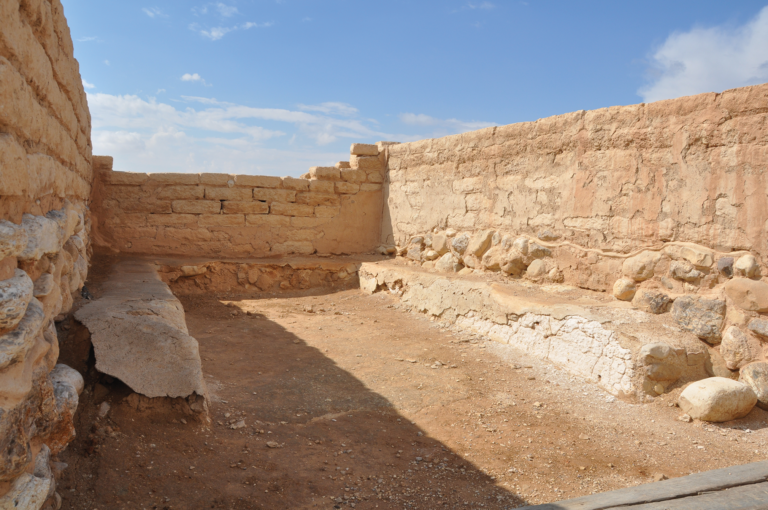
Tel Shiqmona was a small, fortified industrial site on the Carmel coast that operated in the ninth and eighth centuries BCE as an important economic center under the control of the Kingdom of Israel. It is considered the largest purple dye factory known from the Iron Age in the Mediterranean region. Previous excavations were conducted at the site in the 1960s and 1970s, and in 2011–2013. The site contains the world’s largest concentration of finds associated with purple dye production, comprising more than 170 items, most of them stained with the dye itself. The finds include remnants of dozens of ceramic vats for producing and applying the dye, each with a capacity of approximately 350 liters. The excavations also exposed the buildings and production installations, but did not make it possible to reconstruct how their use changed over time. In the present study, the researchers excavating the site—Dr. Golan Shalvi, Sonia Pinsky, and Prof. Ayelet Gilboa of the Zinman Institute of Archaeology at the University of Haifa—sought to combine microscopic analysis of the activity layers at the site through collaboration with the Environmental Microhistory Laboratory in the Department of Maritime Civilizations at the University of Haifa, led by Prof. David Friesem and Dr. Roni Zuckerman-Cooper. Dr. Isaac Ogloblin-Ramírez, together with Madeline Jacobson from the Leon Recanati Institute for Maritime Studies at the University of Haifa, analyzed microscopic activity residues in the laboratory and succeeded in deciphering which activities were carried out in the workspaces at Tel Shiqmona and how they were managed and maintained between alternating uses.
The study focused on a layer dating to approximately 790–740 BCE, during the reign of Jeroboam II and the peak of industrial activity at Tel Shiqmona. It was based on an excavation conducted at the site in 2023 and on systematic sampling of sediments accumulated in two workspaces. During the excavation, the researchers collected soil samples from the different layers, including intact blocks of soil. In the laboratory, they examined the samples using Fourier-transform infrared (FTIR) spectroscopy, which identifies the composition of materials and signs of exposure to heat. The researchers also used a microscope to study thin sections prepared from the samples, in order to trace the way in which minute layers were formed and accumulated. In addition, they measured tiny remnants of plants, wood ash, and animal dung. Combining the visible finds with the microscopic finds and the precise location of each sample enabled the researchers to distinguish between the different activities carried out in the spaces and to identify maintenance operations performed between them.
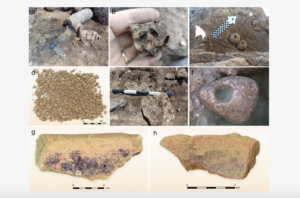
The study’s results indicate that one of the two spaces examined was used at different times for pressing olives and keeping animals. A stone used for crushing olives and a sediment in which impressions of olives had been preserved provided evidence of olive pressing, while microscopic remains of animal dung and trampling marks indicated the existence of an animal pen. Two loom weights found in their original locations point to activity related to textiles. Nearby, in the second space, a pile of crushed murex shells was found, as well as dozens of unburned olive pits, a weight from an olive press, and pottery fragments from dyeing vats bearing purple dye residues. Based on the known timing of the activities, the researchers developed a seasonal model: olive pressing in autumn, keeping animals in winter, and activity related to textiles in spring. The researchers believe that purple dye production was also integrated into this cycle of activities, but it is still impossible to determine in which season it took place. Layers of dung sealed with ash indicate a planned, controlled transition between uses. The researchers believe that the ash was used to disinfect the space, reduce odors, and control pests before it returned to industrial activity. “In a conventional excavation, we see the installations and the large finds, but sometimes a much more detailed story is preserved within the layers of soil. Within these layers, we identified traces that cannot be seen with the naked eye, but only under a microscope. This makes it possible to reconstruct not only what was done in the structure, but how its use changed over time,” said Dr. Ogloblin-Ramírez. Prof. Friesem adds: “The combination of the archaeological finds uncovered in excavations with the microarchaeological finds revealed in the laboratory opens a window to a new understanding of ancient activity. There is no reason why the planned activity and seasonal pattern that we see at Shiqmona should not also be discovered at other sites through integrated research. Improving efficiency and maximizing the use of resources and space was clearly a feature of ancient societies, no less than it is of our own.”
Published in the journal PLOS ONE