Two Bar-Ilan University Researchers Win Prestigious ERC Starting Grants, Securing Over $4 Million in Funding

Two Bar-Ilan University researchers have received prestigious ERC Starting Grants from the European Research Council, securing a combined €3,472,380 (more than $4 million) to pursue groundbreaking research that challenges established assumptions in mental health and computer science. Prof. Reuma Gadassi-Polack of the Faculty of Education and Gonda Brain Research Center received €1,973,365 ($2.3 million), while Dr. Arnold Filtser of the Department of Computer Science and Artificial Intelligence received €1,499,015 ($1.74 million). The grants support research that takes a fresh look at fundamental questions in two very different fields. Gadassi-Polack is challenging conventional thinking about the direction of influence within families, while Filtser is developing new algorithmic tools for settings in which measures of distance, cost, or dissimilarity do not satisfy the mathematical properties that define a metric.
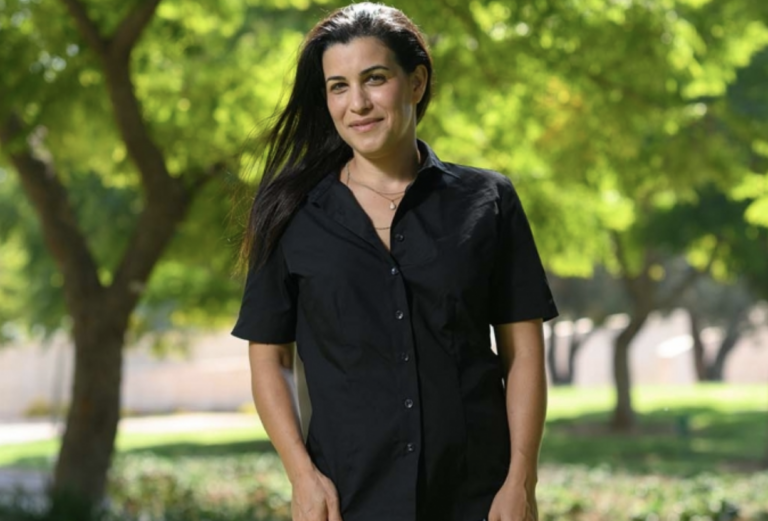
Prof. Reuma Gadassi-Polack of the Faculty of Education and Gonda Brain Research Center and a practicing clinical psychologist is using her ERC grant to challenge the way researchers have traditionally studied mental health in families. Most research on childhood depression and anxiety has focused on how parents affect their children—through genetics, parents’ own symptoms, parenting behaviors, or both. Gadassi-Polack’s Child2Parent project turns this perspective around, asking a largely overlooked question: Can children’s emotional difficulties also affect their parents’ mental health?
The project will develop the first mechanistic model of child-to-parent symptom transmission, focusing on the everyday processes through which parents help their children regulate emotions (i.e., change the intensity and duration of emotional experience and expression). Gadassi-Polack will study mother-adolescent pairs using a combination of hormonal measures, brain imaging, and information gathered from participants’ daily lives. By shifting the focus from what parents do to children to what children may (inadvertently) do to their parents, the project could provide a new understanding of how mental health difficulties develop and spread within families and ultimately help inform interventions that support the family as a whole.
Dr. Arnold Filtser of Bar-Ilan University’s Department of Computer Science and Artificial Intelligence is developing algorithmic tools for settings in which distance does not obey the standard rules of a metric space. Many algorithms for routing, data search, network design, and grouping similar objects rely on metric embeddings—a powerful mathematical technique that has been developed primarily for metric spaces. However, many important measures of cost, distance, or dissimilarity do not form metrics. In a metric space, the distance from A to B is the same as the distance from B to A, and traveling from A to B through an intermediate point cannot be shorter than traveling there directly. Real-world costs need not obey either rule: a flight from A to B may cost differently from a flight from B to A, and an itinerary with a stopover may be cheaper than a direct flight.
Filtser’s ERC-funded project, “(Non) Metric Embeddings,” aims to extend the powerful toolkit of metric embeddings to these non-metric settings. Metric embeddings replace complicated distance data with a more structured representation while preserving distances approximately, allowing algorithms to exploit this additional structure. By developing analogous tools for non-metric distances, the project could lead to more efficient algorithms for transportation and communication networks, improve network design, and open new approaches to problems that existing metric techniques cannot adequately address. The ERC Starting Grant is one of Europe’s most prestigious funding programs for promising early-career researchers. Awarded by the European Research Council, the grants support researchers with outstanding research records who are pursuing ambitious, innovative ideas with the potential to make a significant impact in their fields.
Together, the two grants reflect the breadth of research at Bar-Ilan University, where researchers are challenging established assumptions and developing new approaches to fundamental questions across disciplines—from the dynamics of mental health within families to the mathematical foundations of complex networks. The $4 million in new ERC funding further strengthens Bar-Ilan University’s growing international research profile and its position among Israel’s leading research institutions.