Tracking Africa’s Changing Lands: The Weizmann Mobile Lab Sets Out on a New Climate Mission
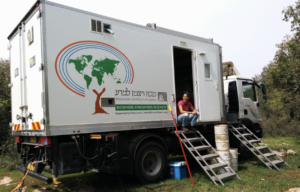
Africa’s landscapes are transforming faster than almost anywhere else on Earth, yet the continent remains one of the world’s largest blind spots in climate observations. This year, a unique scientific expedition aims to change that. After a months-long sea journey around the continent, the Weizmann Institute’s fully equipped Biosphere–Atmosphere Research Mobile Lab is about to roll onto African soil, launching an ambitious campaign to measure how land-use change is reshaping the region’s carbon, water, and energy cycles. Led by Prof. Dan Yakir, Dr. Eyal Rotenberg, Dr. Dan Elhanati, and their students and postdocs team, the mission brings state-of-the-art climate science directly to places where nearly no ground-based measurements exist, opening a rare window into East Africa’s rapidly shifting environments.
Tracking Africa’s Changing Lands: The Weizmann Mobile Lab Sets Out on a New Climate Mission
Africa’s landscapes are transforming faster than almost anywhere else on Earth, yet the continent remains one of the world’s largest blind spots in climate observations. This year, a unique scientific expedition aims to change that. After a months-long sea journey around the continent, the Weizmann Institute’s fully equipped Biosphere–Atmosphere Research Mobile Lab is about to roll onto African soil, launching an ambitious campaign to measure how land-use change is reshaping the region’s carbon, water, and energy cycles. Led by Prof. Dan Yakir, Dr. Eyal Rotenberg, Dr. Dan Elhanati, and their students and postdocs team, the mission brings state-of-the-art climate science directly to places where nearly no ground-based measurements exist, opening a rare window into East Africa’s rapidly shifting environments.
Biosphere Atmosphere Research Mobile Lab
The deployment follows an intensive preparation phase of more than a year, during which the team completed a comprehensive systems overhaul, calibration of instrumentation, and logistical planning for overseas shipment and operation under field conditions. The lab, housed within a truck, enables high-precision measurements across diverse land-cover types, offering an unprecedented opportunity to characterize land–atmosphere interactions in regions where data have long been scarce.
During this campaign, the Mobile Lab will conduct various measurements with a suite of high-precision instruments. These include an eddy-covariance system for continuous measurements of turbulent fluxes, gas analyzers for CO₂, CH4, H₂O, and fire-related trace gases, radiation sensors for evaluating surface energy balance components, and meteorological sensors mounted on an extendable mast.
This station, the sole Israeli contribution to the global FLUXNET, a network of regional earth system scientists, has already added invaluable pieces to the picture of global climate change, published in leading scientific journals.
A Research Route Across Africa’s Climate Gradient
The first phase of the campaign, starting in mid-January 2026, will focus on Kenya, a region characterized by one of the most pronounced climatic and ecological gradients in East Africa.
With this setup in place, Prof. Yakir explains its importance: “land use and land cover are changing dramatically due to climate change, increasing population, and changes in management. We need to be able to predict the implications of the changes in land uses for carbon storage and crop productivity, in water availability, and in environmental conditions.”
By deploying the mobile lab along the gradient in Kenya, the project will directly measure how different land-use regimes influence carbon sequestration potential, water vapor exchange, and energy partitioning at the surface. In agricultural regions, for example, changes in vegetation structure and albedo may alter heat fluxes, in shrublands, variability in precipitation and soil moisture controls biophysical responses, and in savanna systems, fire activity introduces distinct atmospheric signatures detectable through gas and aerosol (small airborne particles) measurements.
Building on the Kenyan transect, the lab will continue its two-year mission, traveling southward through East Africa. It will trace one of Earth’s most striking environmental gradients, capturing how climate, vegetation, farming practices, and fire regimes shape the climate and atmosphere above them. The result will be the most extensive, fine-scale dataset ever collected across this part of Africa, forming a critical backbone for future climate models, satellite calibration, and sustainable land-management strategies.
This long-term research expedition brings scientific presence and professional measurements to a region where reliable on-the-ground information is urgently needed. By bringing advanced measurement capabilities directly to Africa’s landscapes, the Weizmann team is helping fill one of the biggest data gaps in the global climate system, which will help unfold the continent’s future and its potential consequences for the planet.
The project is carried out in collaboration with local research institutions, including the Taita Hills Research Station (University of Helsinki) and the Mazingira Centre in Nairobi, Sokoine University of Agriculture in Tanzania, the University of Botswana, as well as partners, and in the other counties along the East Africa transect. These collaborations support logistical coordination, data integration, and long-term monitoring capacity.